May 20, 2024
StudyFlow: The SQE Study System Built Around Three Questions That Actually Matter
Read Time
8 Min
Category
Study Strategy

At any point in your SQE preparation — whether you are working through SQE1 or building towards SQE2, you should be able to answer three questions without hesitation:
What have I actually covered?
Am I ready?
What should I do next?
Most candidates can't. Not because they haven't been working hard — most have. But because the tools they're using to prepare don't give them that information. A question bank tells you your score. A set of notes tells you what you've written down. A calendar tells you what sessions you've blocked out. None of them tell you where you actually stand.
StudyFlow is built to answer those three questions precisely — across both stages of the SQE.
The Problem With How Most Candidates Prepare
The typical SQE preparation setup is a combination of tools that weren't designed to work together: a commercial question bank, lecture notes or a prep course, a calendar, and a rough sense of which subjects have had the most attention.
The problem is not the individual tools — a question bank is valuable, lecture notes are necessary. The problem is that none of them produce a coherent picture of preparation. Coverage is assumed rather than tracked. Revision is scheduled by feel rather than by data. Blind spots only become visible when you sit a mock test or, worse, on assessment day.
SQE1 alone has 166 topics across FLK1 and FLK2 — 77 in FLK1 and 89 in FLK2. SQE2 adds six practical legal skills to develop across five practice areas. At that scale, across both stages, intuition is not a reliable guide. You need a system that translates study activity into structured progress.
What StudyFlow Is
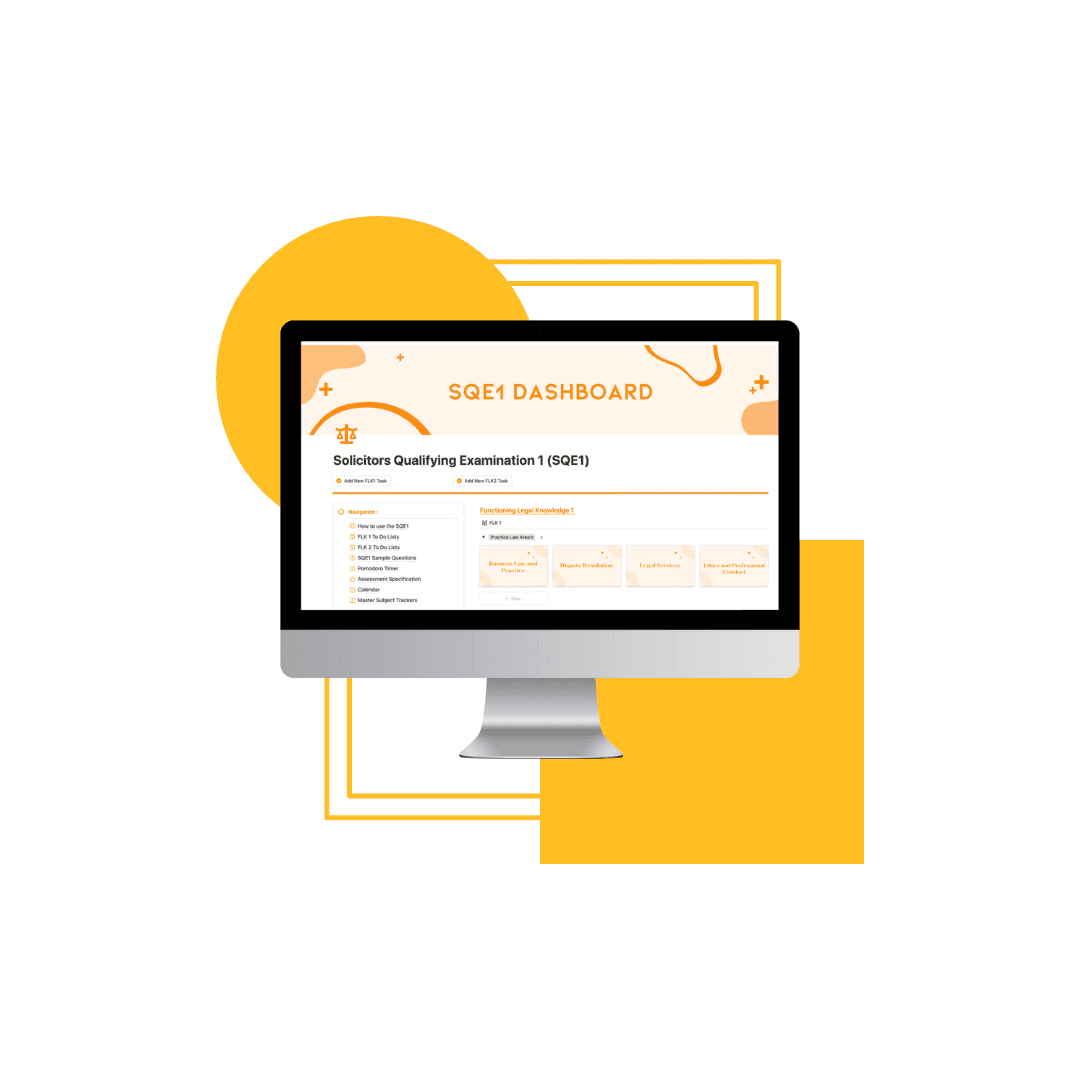
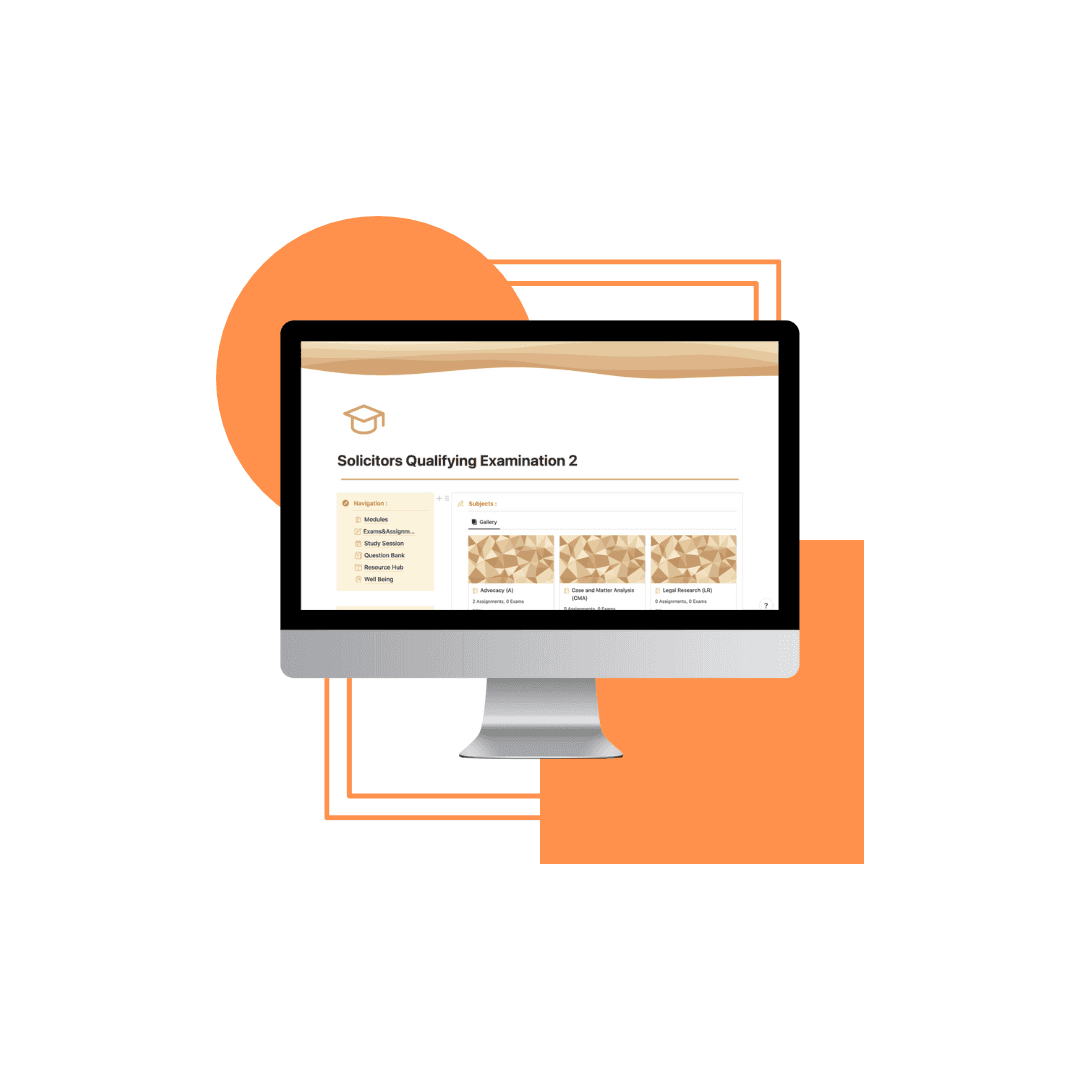
StudyFlow is a structured study system for SQE candidates — built to cover both SQE1 and SQE2 within a single workspace. It is not a note-taking tool. It is not a question bank. It is not a simple tracker.
It is a system that takes your study activity — every session you log — and converts it into a precise, real-time picture of where you stand across the full SQE syllabus. Coverage, retrieval, mastery, spacing — tracked simultaneously, surfaced clearly, acted on intelligently. Whether you are working through the 166 topics of SQE1 or preparing the practical skills required for SQE2, the system works the same way.
The design philosophy is deliberate: clarity over complexity, structure over flexibility, decisions over data dumps. Every feature exists to help you answer those three questions faster and more accurately.
How It Works
The foundation of StudyFlow is the study log.
Every time you study, you log a session: the exam, the subject, the topic, the study mode (lecture, MCQ practice, flashcards, active recall), the duration, and the date. That is it. The logging is factual — not interpretive. You record what you did. StudyFlow derives what it means.
From that data, the system calculates four distinct metrics for every topic across the syllabus:
Coverage — whether you have started a topic at all. A topic is covered the moment it has one logged session.
Retrieval — whether you have tested yourself on the topic, not just read about it. Topics with MCQ practice, flashcards, or active recall sessions are flagged as having retrieval evidence — a meaningful distinction because passive coverage and active recall produce very different outcomes on assessment day.
Mastery — whether a topic has both retrieval evidence and sufficient study depth to indicate genuine understanding rather than surface familiarity.
Spacing — whether a topic has been studied recently enough that it is not decaying. A topic covered thoroughly three months ago and not revisited is not prepared — it is a risk.
These four metrics run simultaneously across all 166 SQE1 topics and the six practical legal skills across five SQE2 practice areas. The result is a study system that reflects the actual complexity of full SQE preparation rather than reducing it to a single progress bar.
What StudyFlow Shows You
The Overview Dashboard
The dashboard is the command centre. It shows you, at a glance:
Total coverage — how many topics you have started, broken down by exam (SQE1 or SQE2) and by FLK1 and FLK2 separately within SQE1
Retrieval rate — of the topics you have covered, how many have active recall or MCQ practice logged
Prepared topics — the number with both retrieval evidence and sufficient mastery
Spacing status — topics that have not been revisited recently enough and are beginning to decay
Study pace — your activity level over recent sessions
Exam countdown — time remaining until your assessment date
This is not a motivational dashboard. It is an operational one. The numbers tell you exactly what your preparation looks like at this moment — not how you feel about it.
The Specification View
The specification page shows the full SQE syllabus — all 166 SQE1 topics across FLK1 and FLK2, and the six practical legal skills across five SQE2 practice areas — in two formats.
Heatmap view — a visual grid of every topic, colour-coded by progress status. At a glance, you can see the shape of your preparation: which subjects are well-covered, which are patchy, and which have not been touched. The heatmap makes gaps visible in a way that a list cannot.
List view — the full subject-to-topic hierarchy in table format, sortable and filterable.
In both views, clicking any topic opens a Topic Detail Sheet showing the topic's full session history, total time invested, last studied date, decay status, and current mastery level. This is where the system earns its depth — every topic has a story, and you can read it.
Next Recommended Topic
StudyFlow does not just show you where you stand — it tells you what to do next. The recommendation engine surfaces the highest-priority topic at any given moment, factoring in coverage gaps, spacing decay, and retrieval status. Rather than deciding where to spend your next session by feel, you open StudyFlow and it tells you.
This is the feature that directly answers the third question: what should I do next?
Signals and Insights
The signals panel highlights the things most likely to affect your result if left unaddressed — topics with significant decay, subjects with coverage but no retrieval, areas being neglected relative to assessment weighting. These are not generic reminders. They are derived from your specific study data.
The Plan System
StudyFlow includes a planning layer for structuring future study. You create study blocks, assign topics to them, and mark them complete as you go. This closes the loop between the system's recommendations and your actual study schedule — rather than keeping preparation planning in a separate calendar or document.
Who StudyFlow Is Built For
StudyFlow is built for four types of SQE candidates:
Candidates preparing for SQE1 full-time who are covering significant ground each week and need a system that keeps pace — surfacing what needs revisiting before it decays and ensuring retrieval practice keeps up with coverage across all 166 topics.
Candidates studying alongside work who have limited preparation time and cannot afford to spend it on topics they already know well. The recommendation engine and spacing tracker make every session count by directing attention to the highest-priority areas.
Candidates moving from SQE1 into SQE2 who need to shift from knowledge tracking to skills development. StudyFlow covers both stages, so there is no need to rebuild a preparation system when you move from one assessment to the other.
Candidates who have attempted either assessment before and need to understand precisely where their preparation fell short. The topic-level data makes it possible to audit a previous attempt with accuracy rather than guesswork.
What all four have in common is this: they need to know where they stand. StudyFlow is built to tell them.
StudyFlow Is Currently in Private Beta
StudyFlow is live and available to a limited group of beta users. The core system — study logging, coverage engine, dashboard, specification view, plan system, and billing — is fully built and working.
If you are currently preparing for the SQE and want a structured system rather than a collection of disconnected tools, this is the right time to get involved.
Beta users shape the product. The features built in the coming months will reflect real preparation challenges from real candidates — and beta users will have the earliest access to them.
Join the StudyFlow waitlist!
Get access now and begin your SQE preparation — SQE1, SQE2, or both — with a system that actually tells you where you stand.